Guide · Culture
The Jomon and Yayoi periods: pottery before farming, then rice
Japan's oldest pottery was made by foragers who did not farm. Rice came later via Kyushu. Where to see both eras today, with fees and hours.
Japan’s oldest pottery is roughly 16,000 years old, and it was made by people who did not farm. They lived in the Jomon period, which ran from roughly 14,000 BC to 300 BC. Rice farming and metal arrived in northern Kyushu around the start of the Yayoi period, which ran from roughly 300 BC to AD 300. Both eras can be walked through today at reconstructed or excavated settlements.
This page follows the two periods in order, then lists the places to visit. It is the first era page in the history guide and leads into the Kofun and Yamato period.
When were the Jomon and Yayoi periods?
The Jomon ran from roughly 14,000 BC to 300 BC and the Yayoi from roughly 300 BC to AD 300. These are scholarly ranges: sources put the Jomon start between 14,500 and 10,500 BC and the Yayoi start between about 900 and 300 BC.
| When | What happened |
|---|---|
| Roughly 14,000 BC | The Jomon begins; the oldest pottery dates to about this time |
| Roughly 300 BC | Wet-rice farming and metal reach northern Kyushu; the Yayoi begins |
| Roughly AD 300 | The Yayoi ends and the Kofun period follows |
| 2021 | UNESCO inscribes the Jomon Prehistoric Sites in Northern Japan |
How old is Japan’s oldest pottery?
Roughly 15,000 to 16,500 years old, depending on the source. The pottery from Odai Yamamoto I, in Aomori, was dated by radiocarbon on charred food residue at a Nagoya University laboratory. Journal papers put it at about 15,300 to 16,500 years before present, among the oldest known in the world.
Wait, really? The makers were foragers: pottery came first, and farming followed thousands of years later. The site became a National Historic Site in 2013 and is part of the 2021 UNESCO listing.
How did people live before farming?
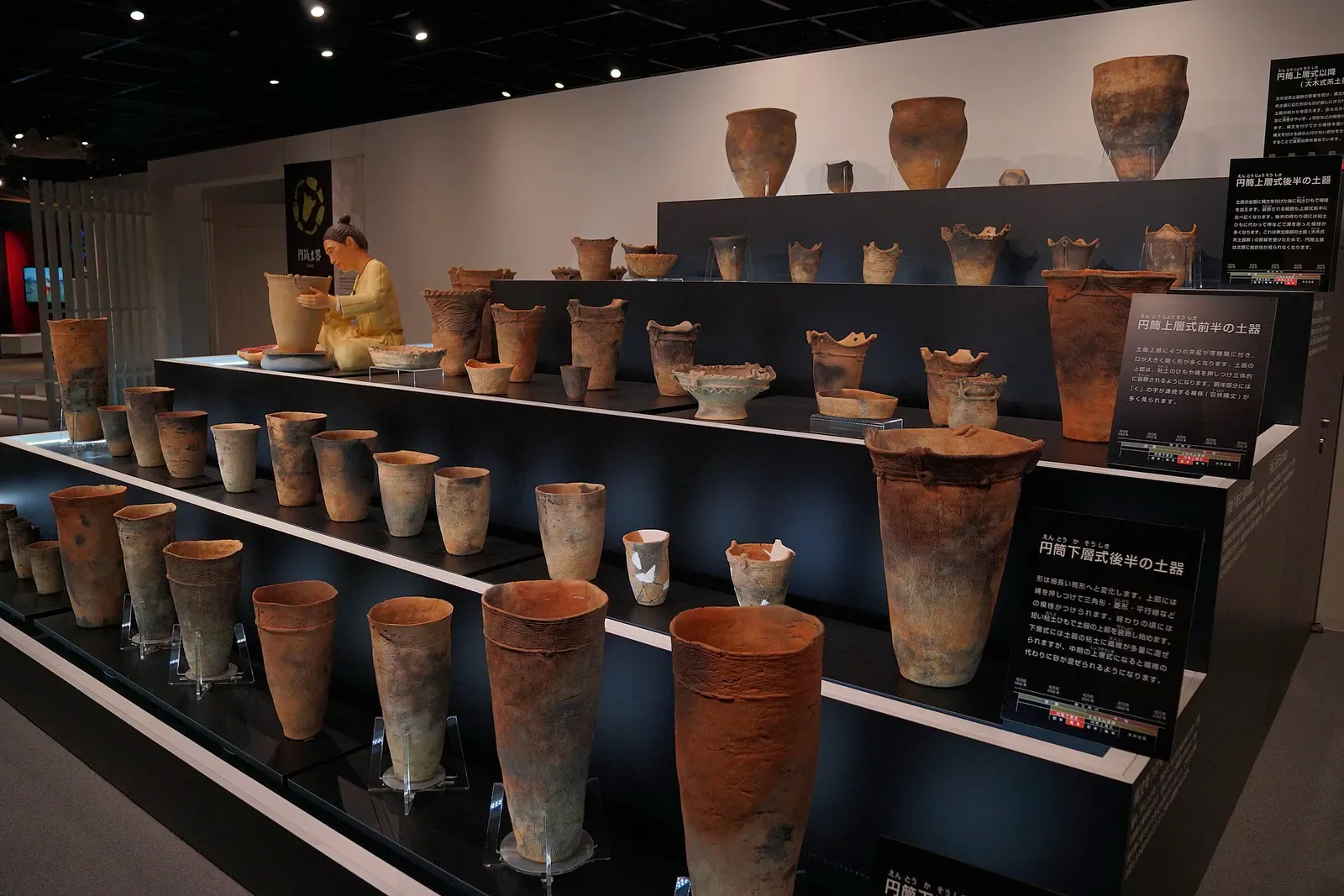
The Jomon were settled, not nomadic. They fished and foraged by season, lived in pit dwellings and left clay figurines called dogu and pots with rope patterns. Shell middens and stone circles mark where they lived and gathered.
Sannai-Maruyama in Aomori is a large Jomon settlement. UNESCO inscribed 17 components of the Jomon Prehistoric Sites in Northern Japan on 27 July 2021, spread across Hokkaido, Aomori, Iwate and Akita.
What changed when rice arrived?
Wet-rice farming and metal came to northern Kyushu from the Korean peninsula. Itazuke, in Fukuoka, is among the oldest known rice villages, and it was moated.
The break is not clean. Paddy traces from the late Jomon at Itazuke challenge the idea that rice marks the Yayoi. Historians also still debate whether newcomers or local people drove the change.
Later in the Yayoi, villages grew into moated, stratified settlements with storage buildings. Bronze bells, mirrors and weapons appear, and small polities formed.
What changed for ordinary people?
Yayoi farmers worked rice paddies, stored grain in granaries and used bronze and iron tools, and differences in rank grew. In Hokkaido and north-eastern Honshu the hunter-gatherer way of life continued while Kyushu and the west took up rice.
Was Yoshinogari the capital of Queen Himiko?
Not proven. Himiko, queen of Yamatai, appears only in a Chinese chronicle, the Wei record. The location of Yamatai is unresolved.
Yoshinogari Historical Park in Saga is the largest moated Yayoi settlement, about 40 ha, with reconstructions. Its official guide links the layout to the chronicle’s description of Yamatai, but the link is not proven.
See it today
Two sites carry the story and they are far apart: Sannai-Maruyama, at the north end of Honshu, shows the Jomon, and Yoshinogari, on Kyushu, shows the Yayoi. Plan them as separate stops. The Tokyo National Museum holds both periods in one building, which suits a Tokyo-only trip.
| Place | City | What you see | Fee | Hours |
|---|---|---|---|---|
| Sannai-Maruyama | Aomori | A large Jomon settlement and the Jomon Culture Center | Check the official page; sources conflict | 09:00 to 17:00 |
| Yoshinogari Park | Saga | The largest moated Yayoi settlement, with reconstructions | Last known $3 (¥460) adult; $1 (¥200) aged 65 and over; under 15 free | 09:00 to 17:00 (Apr, May, Sep to Mar); 09:00 to 18:00 (Jun to Aug) |
| Tokyo National Museum | Tokyo | Honkan galleries with Jomon pottery, dogu, Yayoi pots and bronze bells | Not found | 09:30 to 17:00, last entry 30 minutes before |
| Oyama Furusato Museum | Aomori Prefecture | Listed for the Odai Yamamoto I pottery shards | Not found | Not found |
Dollar figures use about ¥155 to US$1 and are rounded; you pay in yen, so check the rate.
Sannai-Maruyama closes on the fourth Monday of each month (the next day if that Monday is a holiday) and around 30 December to 1 January. Special exhibits cost extra, and last admission is 18:00 during Golden Week and from 1 June to 30 September.
Yoshinogari closes on 31 December and on the third Monday and Tuesday of January, and it may close in a typhoon.
Where next?
- Later: the Kofun and Yamato period, when giant tombs spread across Japan.
- The history guide places every era on one timeline.
- The temples and shrines guide lists the main sites that came after, with fees and hours.
- The Culture hub holds every culture topic, and the culture guide gives the overview.
Questions
Roughly 14,000 BC to 300 BC for the Jomon and roughly 300 BC to AD 300 for the Yayoi. Sources disagree on the starts: the Jomon from about 14,500 to 10,500 BC, the Yayoi from about 900 to 300 BC.
Roughly 15,000 to 16,500 years old, depending on the source. Radiocarbon dating of the Odai Yamamoto I site in Aomori puts its pottery among the oldest known in the world, made by people who did not yet farm.
The Jomon were settled hunter-fisher-gatherers with no farming. The Yayoi grew wet rice and used bronze and iron, and rank differences grew. Rice and metals reached northern Kyushu from the Korean peninsula.
The adult fee is unclear right now: the official page and a second source disagree, so check the official page. The site is closed on the fourth Monday of each month and around 30 December to 1 January.
Not proven. The park's official guide links its layout to a Chinese chronicle's description of Yamatai, Himiko's realm, but the location of Yamatai is unresolved.