Guide · Culture
The Asuka and Nara periods: Buddhism, law and the first capital at Nara
From the arrival of Buddhism to the Great Buddha of 752 and the move to Kyoto in 794. Horyuji and Todai-ji today, with fees and hours.
Buddhism, a written legal code and a planned capital all arrived in the Asuka and Nara periods, which run from about 538 or 592 to 794. The state registered its farmers in 701, built a capital at Nara in 710 and dedicated the Great Buddha at Todai-ji in 752. Horyuji and Todai-ji still stand from this era and are open to visit.
This page follows the turning points in order, then lists the places to see. It follows the Kofun and Yamato period and leads into the Heian period.
When were the Asuka and Nara periods?
Asuka ran from about 538 or 592 to 710, and Nara from 710 to 794. Sources date the Asuka start to either 538 or 592.
| When | What happened |
|---|---|
| 538 or 552 | Buddhism arrives through Baekje (sources differ; both doubtful) |
| 604 | The Seventeen-Article Constitution, credited to Prince Shotoku |
| 701 | The Taiho Code sets up a law-based state |
| 710 | The capital moves to Heijo-kyo, today's Nara |
| 735 to 737 | A smallpox epidemic |
| 752 | The Great Buddha at Todai-ji is dedicated |
| 794 | The capital moves to Heian-kyo, today's Kyoto |
How did Buddhism win its place?
By winning a clan fight. The Nihon Shoki gives 552 for Buddhism’s arrival from the Korean kingdom of Baekje, and other sources give 538. Both dates are doubtful.
The Soga clan backed the new religion, and Soga no Umako is the name tied to that side. The Mononobe and Nakatomi opposed it, and the Soga won.
What is Prince Shotoku credited with?
The Seventeen-Article Constitution of 604. Prince Shotoku served as regent for Empress Suiko. Modern scholars question much of the traditional picture of him, so treat the constitution as a credited work, not a settled fact.
When was the Horyuji pagoda really cut?
In 594, according to tree-ring dating.
Wait, really? The central pillar timber of Horyuji’s five-storey pagoda was felled that year, about a century before the traditional early 8th-century date and before the temple’s 670 fire record. The source is a Nara National Research Institute for Cultural Properties monograph on a 2001 survey.
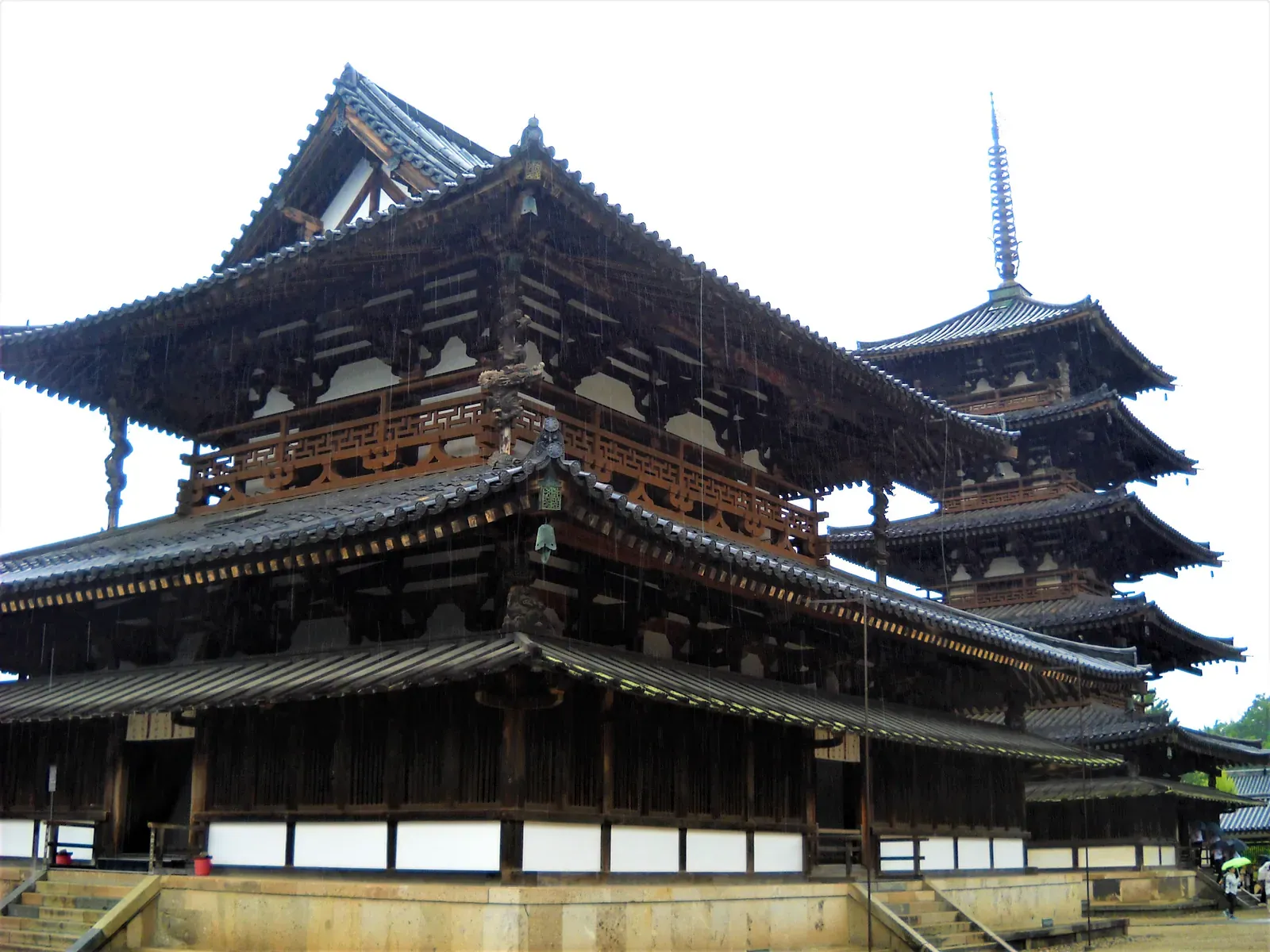
A felling date is not a construction date, so the pagoda itself may be later. Even so, the timber is old. Horyuji’s Western Precinct buildings are among the oldest surviving wooden structures in the world, and UNESCO listed the temple in 1993.
How did the law code change farm life?
From 701 the Taiho Code registered households and allotted rice land by age, sex and rank. In return, farmers owed four things:
- Grain tax (so) on their land.
- Local products or cloth (cho).
- Labour or cloth (yo).
- Compulsory loans (suiko).
A 2020 study estimates that 30 to 40% of peasant income was taken, with enforcement weakening later in the 8th century.
Why does Nara have a Great Buddha?
Emperor Shomu ordered it, and it was dedicated in 752. The Buddha is about 15 m tall and used a great deal of bronze. In 735 to 737 smallpox killed many nobles, including all four Fujiwara brothers, and one estimate says a quarter to a third of the population died. Estimates conflict.
Many accounts link the epidemic to the Buddha, but no source states a direct cause, so the link is an account, not a fact. The court left Nara for Nagaoka-kyo in 784 and moved again to Heian-kyo in 794, where the Heian page picks up.
See it today
Two places in Nara Prefecture carry the story. Horyuji, in Ikaruga, holds the oldest wooden buildings; Todai-ji and the Heijo Palace Site, both in Nara, show the capital era.
| Place | City | What you see | Fee | Hours |
|---|---|---|---|---|
| Horyuji | Ikaruga | The Kondo, Chumon and five-storey pagoda; UNESCO since 1993 | $13 (¥2,000) adult, cash only; $11 (¥1,700) junior high; $6 (¥1,000) primary | 08:00 to 17:00 (22 Feb to 3 Nov); 08:00 to 16:30 (4 Nov to 21 Feb) |
| Todai-ji | Nara | The Daibutsuden hall and the Great Buddha | Hall $5 (¥800); museum $5 (¥800); joint $8 (¥1,200); ages 6 to 12 $3 (¥400) | Hall 07:30 to 17:30 (Apr to Oct), 08:00 to 17:00 (Nov to Mar) |
| Heijo Palace Site | Nara | Reconstructed Daigokuden and Suzakumon on the 710 to 784 capital site | Park entry not found | 09:00 to 16:30, last entry 16:00; closed Mondays |
| Nara National Museum | Nara | Buddhist art | Not found | Not found |
Dollar figures use about ¥155 to US$1 and are rounded; you pay in yen, so check the rate.
Horyuji’s ticket covers the Saiin, Daihozoin and Toin precincts, and entry ends 30 minutes before closing. No closed days are listed for Horyuji or, on its English pages, Todai-ji.
At the Heijo Palace Site, the Daigokuden, Suzakumon, East Garden and exhibition hall open 09:00 to 16:30 and close on Mondays (the next day if Monday is a holiday) and at New Year. The Izanaikan and information center open 09:00 to 17:00, with last entry 16:30. They close on the second Monday of February, April, July and November and from 29 December to 1 January.
Where next?
- Earlier: Kofun and Yamato. Later: Heian.
- Nara, Osaka, Koyasan and Ise temples and shrines has Todai-ji, Kasuga Taisha and Horyuji in more detail, with closed days and goshuin.
- Kyoto temples and shrines covers the city the court moved to in 794.
- The temples and shrines guide lists every main site in one table.
- The history guide places every era on one timeline. The Culture hub holds every culture topic.
Questions
Asuka ran from about 538 or 592 to 710, and Nara from 710 to 794. The Nara period began when the capital moved to Heijo-kyo, today's Nara, and ended when it moved to Heian-kyo, today's Kyoto.
The Nihon Shoki says 552 and other sources say 538. Both dates are doubtful. It came through the Korean kingdom of Baekje, and the Soga clan backed it against the Mononobe and Nakatomi.
It is among the oldest. Horyuji's Western Precinct buildings are among the world's oldest surviving wooden structures, and UNESCO listed the temple in 1993. Tree-ring dating shows the five-storey pagoda's central pillar was felled in 594.
Emperor Shomu ordered it and it was dedicated in 752. A smallpox epidemic in 735 to 737 killed many nobles just before. Linking the two is a common account, but no source states a cause.
Horyuji charges adults $13 (¥2,000) in cash only. Todai-ji's Great Buddha Hall costs $5 (¥800), its museum $5 (¥800) and a joint ticket $8 (¥1,200).