No.08 · Regions
Okinawa travel guide: pick your islands and season
Naha and Shuri, Kerama whales, Ishigaki and Yaeyama: pick a trip and a season, with ferry fares, typhoon rules and the 2027 lodging tax.
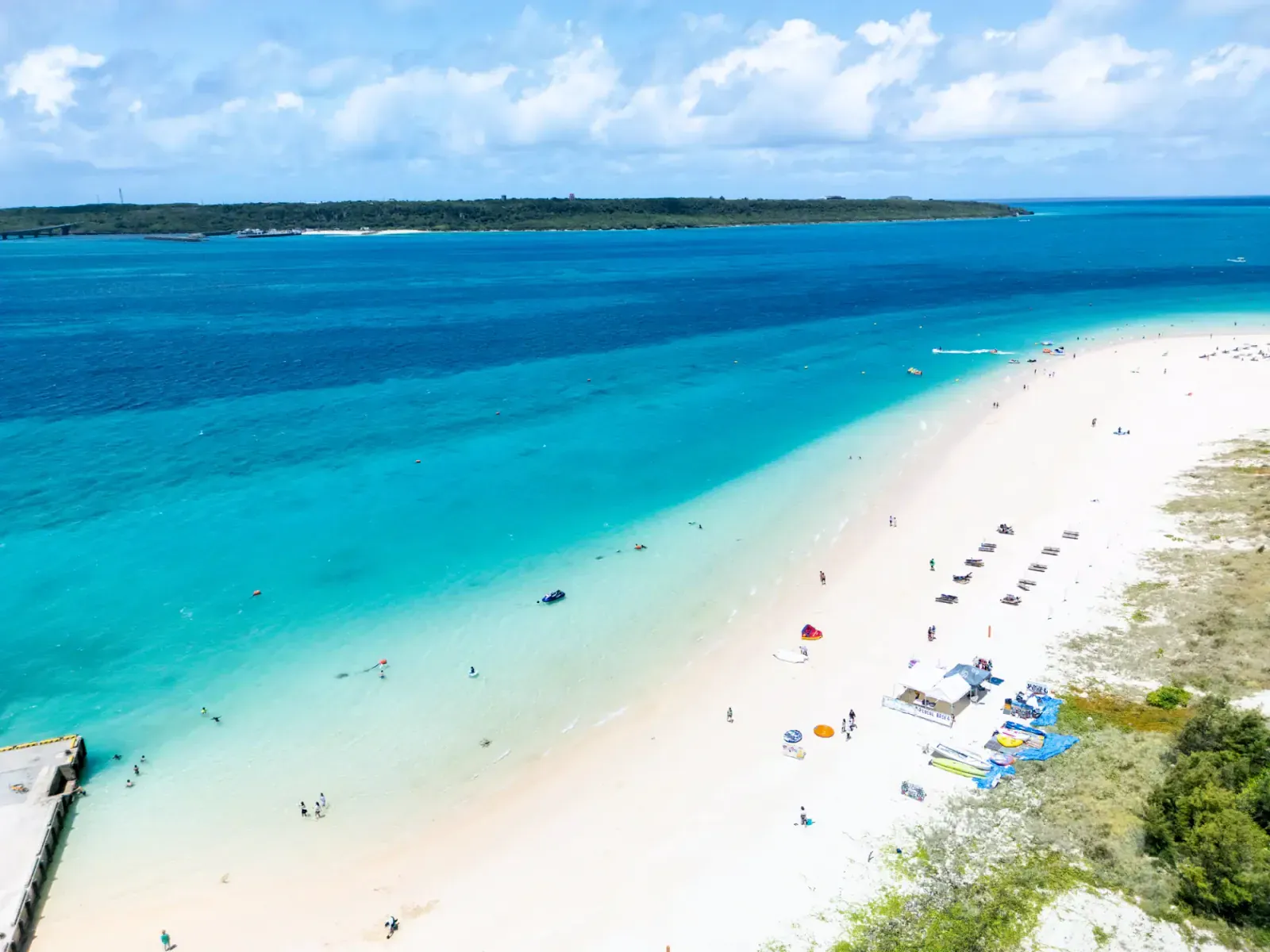
Okinawa is a sea trip: reefs, island ferries and, from January to March, humpback whales off the Kerama Islands. Plan three days for Naha and Shuri, four for the west coast by car, or five for Ishigaki and its islands. Winter is mild but often cloudy, beaches open between March and April, and typhoons can ground flights and ferries for a day or three, as Typhoon Champi did to Ishigaki-area ferries on 22 and 23 October 2026 and to some JAL flights that week. Official sources are named where used; the rest comes from operators and guides and is marked.
Best for: reefs and diving, whale watching from January to March, island hopping, Shuri Castle, Okinawan food, a mild winter escape (Naha averages about 17 °C in January).
Dollar figures use about ¥155 to US$1 and are rounded; you pay in yen, so check the rate. Sums are converted from the yen total, so rounded parts can differ by a dollar or two.
Which trip fits you?
Naha and Shuri is the easiest first trip; Ishigaki and Yaeyama suit divers and island hoppers.
| Trip | Days | Start from | Season | Best for |
|---|---|---|---|---|
| Naha and Shuri | 3 | Naha | Year-round | First visit, no car, food, the castle |
| West coast | 4 | Motobu or Nago, with a car | Sakura late Jan; beaches Apr to Oct | Churaumi Aquarium, coast drives |
| Kerama day trip | 1 | Naha | Whales Jan to Mar; swimming Apr to Oct | Reefs or whales from one hotel |
| Ishigaki and Yaeyama | 5 | Ishigaki | Year-round | Manta, Taketomi, Iriomote |
| Diving | Add-on | Naha or Ishigaki | Year-round; sea averages about 21.5 to 28.6 °C, peaks near 30 °C | Certified divers; trial dives need no card |
Naha and Ishigaki join by a flight of about an hour, so a week covers both.
When should you go?
Go January to March for whales and early cherry blossom, and March or April to October for swimming; typhoon approaches peak in August.
| Season | Months | What is on | Watch out |
|---|---|---|---|
| Winter | Dec to Feb | Humpback whales off Kerama; Japan's earliest cherry blossoms in late Jan; holiday light displays in Dec | Often cloudy or rainy, with cold northerlies; most beaches closed for swimming; boats feel cold |
| Spring | Mar to May | Beach openings in 2026 ran from 5 March to 18 April; whale season ends in late March | Quick temperature swings; the rainy season starts in early May |
| Summer | Jun to Aug | Hot and sunny once the rains end; swimming; eisa dancing and fireworks in Jul and Aug | Rain until late June; box jellyfish Jun to Sep; typhoon approaches peak in Aug |
| Autumn | Sep to Nov | Sep still hot, Oct often sunny, Nov cloudier; tug-of-war festivals in Sep | Typhoons run into October; main-island beaches close at the end of Oct |
No official crowd calendar is found. By the Japan-wide pattern, Golden Week (around 29 April to 5 May), Obon in mid-August and New Year are busy. One ferry guide says Zamami boats fill early from July to September, and February whale trips fill early too.
What is on in winter 2026-27?
Winter brings whales from January, early cherry blossom in late January and mild but often cloudy weather.
- Whales. The Zamami association’s 2026 season ran 8 Jan to 25 Mar, and an older page on its site shows 27 Dec to 5 Apr, undated. The 2026-27 association dates are not published. A Naha operator lists tours from 19 Dec 2026 to 4 Apr 2027 on an Okinawa tourism events page; in 2025-26 its tours ran from about 20 Dec to 5 Apr. February is usually the peak.
- No promises. Rough seas cancel sailings. One operator’s 2026 terms refunded or rebooked a trip with no whale only between 1 Feb and 15 Mar, so read this year’s terms before you pay.
- Boats. Naha trips leave from Mie-gusuku, about 10 minutes by car from the airport, usually twice a day (about 09:00 to 12:00 and 13:30 to 16:30). Other ports are Zamami, Tokashiki, Ginowan Marina, Toya in Chatan and Motobu. The national tourist board says about 2 hours; one operator says 3 hours with about 1 hour among whales. Boats keep at least 100 m from whales, per the Zamami association.
- Price. One operator charges $39 (¥6,000) for an adult, or $37 to $39 (¥5,800 to ¥6,000) with Naha pickup. Another listing shows $41 to $50 (¥6,300 to ¥7,800).
- Cherry blossom. Taiwan cherries at Nakijin Castle ruins reached full bloom in early February in 2026, per one guide. A listing puts the Nago Cherry Blossom Festival on the last Saturday and Sunday of January (30 and 31 Jan 2027 by the calendar) and the Motobu Yaedake peak at 25 Jan to 5 Feb. No 2027 forecast exists yet.
- Weather. Northerly winds make it feel colder, and a coat or sweater is occasionally needed. Ishigaki’s Fusaki Beach allows winter swimming only after you notify the beach station and only while it is supervised.
The Japan Meteorological Agency puts the rainy season at early May to late June; in 2026 it ran from about 4 May to 29 June, per a news report.
Before you book Typhoons can cancel boats for several days. Book refundable ferries for island days.
How do you get to Okinawa?
Fly: Haneda to Naha takes about 2 h 10 to 20, and Ishigaki is 2 h 35 to 3 h 05 nonstop from Tokyo.
| Route | Time | Carriers |
|---|---|---|
| Haneda to Naha | About 2 h 10 to 20 | ANA, JAL, Skymark (Solaseed also listed) |
| Narita to Naha | About 3 to 3.5 h | Peach, Jetstar Japan |
| Tokyo to Ishigaki | 2 h 35 to 3 h 05 | ANA, JAL |
| Tokyo to Miyako | About 3 h | ANA, JAL |
| Naha to Ishigaki | About 1 h | ANA, JAL, Solaseed |
| Naha to Miyako | About 55 min | ANA, JAL |
| Naha to Yonaguni | About 1 h 20 | JAL |
| Naha to Kumejima | About 35 min | JAL |
Times for Naha to the islands come from Visit Okinawa’s flights page, dated June 2025; the Tokyo routes come from guides and flight aggregators. Tokyo to Naha fares for 2026-27 are not found, and the Haneda samples date from 2022, so they are left out. One guide puts Narita fares at $45 to $130 (¥7,000 to ¥20,000), mostly on afternoon and evening departures. Aggregators show Naha to Ishigaki from about $38 to $62 (about ¥5,900 to ¥9,600) one way.
How do you get around?
Naha by Yui Rail. The monorail runs from the airport to Tedako-Uranishi, 19 stations in about 40 minutes, from about 06:00 to 23:30 with trains every 4 to 15 minutes (hours from secondary sources). Adult fares from the airport:
| To | Adult fare |
|---|---|
| Asahibashi | $2 (¥290) |
| Makishi | $2 (¥320) |
| Shuri | $2 (¥360) |
| Tedako-Uranishi | $3 (¥390), end of line |
A travel site lists a 24-hour pass at $5 (¥800) and a 48-hour pass at $9 (¥1,400); another page shows $6 (¥1,000) and $12 (¥1,800), so check the Yui Rail site. At $2 (¥320 to ¥360) a ride, the day pass pays from the third ride. Fares between city stations are not found, so short hops change that sum.
Buses, taxis, bikes. The main island has local, limousine, shuttle and tour buses and the ChuraChari bike share.
To Churaumi. The airport shuttle (Yanbaru Express) costs $12 to $13 (¥1,900 to ¥2,000) one way and bus 117 $18 to $19 (¥2,770 to ¥2,880), one or two an hour. One guide says a little over 2 hours; the aquarium’s page says about 3 hours by express bus. From Nago to the park, buses 65 and 66 run hourly for about 50 minutes at $6 (¥920). By car, the expressway from Naha to Nago costs $7 (¥1,040) one way, and the drive takes about 2 hours. Without a car, a bus tour makes the day for $45 (¥7,000), 10 to 11 hours.
Rental car. You need a paper 1949 Geneva IDP carried with your home licence. Holders of Swiss, German, French, Belgian, Monaco or Taiwan licences use a JAF translation instead. The full answer is in Can I rent a car in winter with an IDP?; its snow-tyre advice is for ski country. You can rent an ETC card, insurance is mandatory, and tolls settle at return.
Ferries. Fares are from an operator aggregator and secondary guides. The Ishigaki figures are for the winter timetable, which runs 1 Oct 2026 to 28 Feb 2027.
| Route | Boat | Time | Adult one way |
|---|---|---|---|
| Naha to Zamami | Fast boat from Tomari | 50 to 70 min | $20 (¥3,140), reported |
| Naha to Zamami | Slow ferry from Tomari | 90 to 105 min | $14 (¥2,120), reported |
| Ishigaki to Taketomi | Ferry | 10 to 15 min | $6 (¥970) |
| Ishigaki to Iriomote | Via Ohara port | 40 to 45 min | $16 (¥2,520) |
| Ishigaki to Iriomote | Via Uehara port | About 50 min | $21 (¥3,290) |
Other Ishigaki boats: Kohama, about 30 minutes, $11 (¥1,720); Kuroshima, $12 (¥1,850), three departures a day; Hateruma, about 80 minutes, $32 (¥4,990), two departures. Zamami return fares conflict between pages: $39 (¥5,970 or ¥6,080) fast, $26 (¥4,030 or ¥4,090) slow. The schedule changes monthly, and one guide says the village booking system takes foreign cards only from 23 days before departure. Taketomi has about ten departures a day from 07:30 to 17:30.
Uehara is often cancelled by high waves in winter, while Ohara is sheltered. If Uehara is off, take Ohara and a bus. Counter queues can pass 30 minutes in peak season, some islands have no ATM (carry about $65 (¥10,000) in cash), and the guide’s advice is to leave at least 3 hours between a return ferry and a flight.
Where should you stay?
Stay in Naha for a first visit without a car, Motobu or Nago for Churaumi and beaches, Ishigaki for Yaeyama and Zamami for Kerama reefs and whales.
| Stay in | Suits | Day trips and times | Watch out |
|---|---|---|---|
| Naha | First visit, no car, food, Shuri, Kerama | Shuri by Yui Rail; Zamami 50 to 105 min by boat; whale boats from Mie-gusuku | Churaumi is a long day without a car or a tour |
| Motobu and Nago | Car renters, resort beaches, Churaumi | Churaumi by car; whale boats from Motobu port; Nago sakura in late Jan | Most sights need a car |
| Ishigaki | Diving, manta, Taketomi, Iriomote | Taketomi, Kohama, Iriomote and Hateruma by boat, 10 to 80 min; Naha 1 h by air | Ferries stop in typhoons |
| Zamami | Kerama reefs and whales; Ama Beach (opened 18 Apr in 2026) | Fast boat from Naha, 50 to 70 min | Boats fill early Jul to Sep |
What are the highlights?
Shuri Castle’s main hall opens on 23 Nov 2026, Churaumi Aquarium anchors the west coast and Makishi Market anchors Naha.
| Sight | Fee | Hours and closed days |
|---|---|---|
| Shuri Castle | Adult $6 (¥1,000) from 23 Nov 2026; high school $5 (¥760); primary and junior high $2 (¥370); under 6 free | Sources differ: closing at 18:00 or 19:00. Closed days not found |
| Churaumi Aquarium | Last known (2025) $14 (¥2,180); the 2026-27 price is unclear right now | 08:30 to 18:30, last entry 17:30, in the Oct to Feb season (one guide) |
| Makishi Public Market | Pay per shop | Per guides: about 08:00 to 20:00 or 22:00 by shop; 09:00 starts reported in Nov to Mar. Closed the 4th Sunday of each month, 1 Jan and lunar new year; Obon varies by shop |
| West coast stops | Not found for Cape Manzamo, Kouri bridge or Nago Pineapple Park | Not found |
Shuri. From 23 Nov 2026 the main hall is open to the public, at the same price with or without hall entry (until 21 Nov the adult fee was $3 (¥400)). The hall interior needs a ticket with a date and time; the castle’s history is in Ryukyu history and Okinawa. Sales for 23 Nov to 31 Dec opened on 1 Sep and 1 Oct, and visits from 1 Jan 2027 can be booked two months ahead. Same-day online sales close 15 minutes before a slot, if any remain, and the Kofukumon ticket office also sells them. Yui Rail drops you at Shuri station.
Churaumi. Allow 60 to 120 minutes. The outdoor dolphin, turtle and manatee shows are free, and feeding shows run twice a day (times not found). A guide says the aquarium closes on the first Wednesday of December and the day after (2 and 3 Dec 2026), but a snippet of the aquarium’s own hours page says no scheduled closing days until 31 Mar 2027. Check that page before you book transport.
Makishi and Kokusai-dori. Kokusai-dori is Naha’s main street, with izakayas and live Okinawan music. At Makishi you buy fish downstairs and have it cooked upstairs for an extra fee. Guides report December opening every day, and second-floor restaurants take last orders at about 20:00.
North and west coast. One Naha day-bus tour strings together the aquarium, Nago Pineapple Park, Kouri (about 25 minutes) and Cape Manzamo (about 30 minutes) for $45 (¥7,000), and its price is listed until 31 Mar 2027.
Yaeyama. One operator listing says swimming is not allowed in Kabira Bay itself (unconfirmed), and Iriomote has its own rules (see the safety section). Miyako has the Irabu Ohashi Bridge, 3,540 m long, toll-free, with no pedestrian path.
What should you eat?
Order goya champuru, Okinawa soba and rafute, and drink Orion Beer or awamori.
- Goya champuru: bitter melon stir-fried with tofu, egg and pork or Spam.
- Okinawa soba: wheat noodles, closer to udon; soki soba comes with soft pork.
- Rafute: braised pork belly in soy and fish broth, sometimes with awamori.
- Also on menus: mimiga (pig’s ear), umibudo (sea grapes), tofuyo, yagi sashimi (goat) and taco rice.
- To drink: Orion Beer, with brewery tours in Nago; awamori, a rice spirit at 30 to 40% alcohol; sanpin-cha, a jasmine tea.
Prices are anecdotal. One guide puts a single dish at $5 to $10 (¥700 to ¥1,500), a soba and champuru lunch set at about $5 (¥800) and an izakaya dinner with a drink or two at $19 to $23 (¥3,000 to ¥3,500) a head. Restaurant booking lead times are not found. Awamori and other drinks are covered in the Japan food guide.
Is there onsen in Okinawa?
Only as hotel and resort spas: Okinawa is not a hot-spring region. No official fee or hours list is found. An older listing names the spa at Rizzan Sea Park Hotel in Onna, at $10 (¥1,500) for outside guests, and the super-sento at Naha Central Hotel; treat both as unconfirmed.
Ask the venue about tattoos: no official policy is found for any Okinawa bath, beach or resort. The Japan-wide answer is in Can I use an onsen with a tattoo?, and beach rules are in Japan beaches by region.
Can you dive in Okinawa without a card?
A guided trial dive needs no card; fun diving requires one. Yonaguni’s winter hammerhead dives usually want Advanced Open Water plus drift experience; sources disagree on the months, so ask the operator. Operators say winter northeasterlies cancel many Yonaguni days and move Ishigaki tours to the south coast. Divers fill in a medical form, and any “yes” needs a doctor’s sign-off. Details in Can I dive in Japan without certification?.
| Ishigaki dive | Price, last known (2025) |
|---|---|
| One fun dive | $84 (¥13,000) |
| Two fun dives | $120 (¥18,500) |
| Three fun dives | $155 (¥24,000) |
| Two-dive intro | $180 (¥28,000) on a 2025 page; $205 (¥32,000) on a 2026 list |
| Manta snorkel | $115 (¥18,000), one operator |
| Manta dives | $130 (¥19,800), Kabira, 4 h, 2 dives |
Fun-dive prices include the boat, lunch and tax (one Ishigaki operator); the 2026-27 prices are unclear right now. Visit Okinawa rates Kerama visibility among the best in Okinawa without giving a figure. The sea averages about 21.5 to 28.6 °C across the year, with peaks near 30 °C, and strong northerlies from November to February make boats cold, so bring a windbreaker.
Operators disagree on the manta season: one puts the north-west spots at April to October and the south at November to March, and other pages say year-round with a Sep to Nov peak. Ask the operator about your dates. Do not touch or chase mantas, or kick coral. Reef and dive rules by region are in Diving in Japan by region.
How do you stay safe on the water and the trail?
Swim inside the nets, keep clear of habu habitats and stay out of caves and crevices.
Safety Box jellyfish (habu-kurage): the prefectural advisory ran 1 Jun to 30 Sep in 2024 and 2025, and one guide says October. Okinawa logged 81 stings in 2025, 40.7% of marine sting and bite incidents, many to tourists. Swim inside nets and cover your skin. For a sting, pour vinegar generously, remove tentacles and cool the skin. Vinegar is wrong for some other jellyfish.
- Currents and lifeguards. Only about 30 of 100-plus beaches have lifeguards, and some have strong currents. Swim at lifeguarded or netted beaches.
- Habu snake. The prefecture’s 2026 advisory ran 1 May to 30 Jun. About 40 to 60 people are bitten a year. Keep at least 1.5 m away from tombs, cane fields, caves and stone walls.
- Emergency numbers. 110 for police and 119 for fire and ambulance. The JNTO Japan Visitor Hotline is 050-3816-2787, open 24 hours.
- Sacred sites. Do not enter caves or crevices, which are often tombs. Stay at open sites with translations.
- Iriomote. No speeding (sources give 30 or 40 km/h), no feeding or flash on animals, no off-roading on beaches, no swimwear in town. Iriomote cats cross roads mostly from about 19:30 to 22:00.
- US bases. Entry needs sponsorship through a visitor control centre. Photography and etiquette rules are not found.
What happens in a typhoon?
Flights and ferries cancel, usually for one to three days around the closest approach. JMA says approaches peak in August; Visit Okinawa says June to September is possible; and Champi shows October is not safe. On 22 and 23 October 2026 it cancelled JAL flights to Naha, Miyako, Ishigaki, Yonaguni and Kumejima on various dates, and the main Ishigaki ferry operator suspended every Ishigaki-area route. Typhoon Khanun in August 2023 cancelled 951 flights over two days and suspended 35 ferry lines, per MLIT figures reported by a news report.
Keep one buffer night before an international flight, and check the sea about 48 hours ahead for Yaeyama boats.
What does Okinawa cost, and what is the lodging tax?
Costs run from a $2 (¥320) monorail ride to a $39 (¥6,000) whale trip, and a 2% lodging tax starts on 1 Feb 2027.
Beds and rental cars are not priced here.
Okinawa’s lodging tax starts on 1 Feb 2027 and applies to nights from that date, whenever you booked; a stay that crosses it pays only for nights from 1 Feb. It is 2% of the room charge before consumption tax, per person per night, capped at $13 (¥2,000), per Okinawa Prefecture. Online booking rates do not include it, so you pay at the property. School trips are exempt. Where a municipal tax also applies, the prefecture’s share is 0.8%, capped at $5 (¥800), and the total does not change; the planned municipalities are Motobu, Onna, Chatan, Miyako, Ishigaki and Nago, not yet confirmed. Reportedly, Ishigaki city takes 1.2%, capped at $8 (¥1,200). One hotel notice taxes elementary-age children; other exemptions are unconfirmed. Rates for other cities are in Hotel taxes in Japan.
Sample itineraries
Three plans, priced from the legs above.
Itinerary 1: Naha in three days (winter, no car)
- Day 1: Yui Rail from the airport to Makishi, $2 (¥320). Kokusai-dori and the market.
- Day 2: Shuri. A 1-day pass at $5 (¥800) covers the rides. Castle entry $6 (¥1,000), with a timed ticket booked ahead. Izakaya dinner.
- Day 3: Whale boat from Mie-gusuku, January to March, $39 (¥6,000) with one operator, booked well ahead for February. From April to October, swap in a Zamami day trip on the fast boat, $39 (¥5,970) return, reported.
Sum: $2 (¥320) + $5 (¥800) + $6 (¥1,000) + $39 (¥6,000) + $2 (¥320) back to the airport = $54 (¥8,440), before beds and meals.
Itinerary 2: West coast in four days (car, winter)
- Day 1: Collect the rental at Naha airport, with a booklet IDP.
- Day 2: Drive about 2 hours to Churaumi (check the 2 to 3 Dec closure), then Kouri and Cape Manzamo, whose hours were not found.
- Day 3: Cherry blossom around Nago or Motobu in late January, and a whale boat from Motobu port, January to March.
- Day 4: Drive back to Naha, then Shuri.
Sum: expressway both ways $13 (¥2,080) + whale boat $39 (¥6,000) + Shuri $6 (¥1,000) = $59 (¥9,080). The whale price is the Chatan listing; Motobu’s is not found. Car hire, fuel, the Churaumi ticket, beds and meals are extra.
Itinerary 3: Ishigaki in five days (Yaeyama)
- Day 1: Fly Tokyo to Ishigaki nonstop, 2 h 35 to 3 h 05.
- Day 2: Taketomi, $6 (¥970) each way.
- Day 3: Iriomote via Ohara, 40 to 45 minutes, $16 (¥2,520) one way. Use Ohara in winter, not Uehara.
- Day 4: Manta snorkel for $115 (¥18,000) with one operator, or a dive; confirm the manta season with the operator.
- Day 5: Fly to Naha (about 1 hour) or Tokyo, with 3 hours between ferry and flight.
Sum: Taketomi return $12 (¥1,880) + Iriomote return $31 (¥4,880) + manta snorkel $115 (¥18,000) = $160 (¥24,760), before flights, beds and meals.
Can I…?
- Rent a car with an IDP? Yes, with a paper 1949 Geneva permit.
- Dive without certification? Yes for a guided intro dive; fun dives need a card.
- Fish without a licence? Depends on the water: small-scale methods only, and no national sea licence found.
- Work remotely on a tourist visa? No. The Digital Nomad status is the route.
- Use an onsen with a tattoo? Depends on the bath, not the law.
Related guides
- Wild and Trek Japan: whales, diving and wildlife rules.
- Whale watching in Japan, month by month, Diving in Japan by region and Japan beaches by region: seasons, prices and rules.
- Ryukyu history and Okinawa: the kingdom and Shuri Castle.
- What changed in Japan in 2026: departure tax, tax-free shopping and hotel taxes elsewhere.
Where next?
- Kyushu, the closest of Japan’s main islands to Okinawa.
- Destinations: every region and island on one page.
- Plan the trip: 2026 rules, passes and money.
Quick answers
When is the best time to visit Okinawa?
January to March for whales, and March or April to October for swimming. The Zamami association's 2026 whale season was 8 Jan to 25 Mar, and the rainy season runs early May to late June. Typhoon approaches peak in August, yet Typhoon Champi still cancelled Ishigaki-area ferries on 22 and 23 October 2026 and some JAL flights across the islands that week.
How many days does Okinawa need?
Three days covers Naha and Shuri. Five covers Ishigaki with Taketomi and Iriomote. Add one buffer night before an international flight, because typhoons cancel flights and ferries for one to three days.
Can you see whales in Okinawa?
Yes, roughly January to March off the Kerama Islands, but no sighting is promised. The Zamami association's 2026 season ran 8 Jan to 25 Mar, February is usually the peak, and rough seas cancel sailings. The association's 2026-27 dates are not published; a Naha operator lists tours from 19 Dec 2026 to 4 Apr 2027.
Do you need a rental car in Okinawa?
Not for Naha, Shuri or the Kerama Islands, which work by Yui Rail and boat. A car helps for Churaumi Aquarium, about 2 hours from Naha by expressway, with a toll of $7 (¥1,040) one way. Rentals need a paper 1949 Geneva IDP, or a JAF translation for some countries' licences.
Is there a lodging tax in Okinawa?
Yes, from 1 Feb 2027: 2% of the room charge per person per night, capped at $13 (¥2,000), paid at the property, per Okinawa Prefecture. It applies by night of stay, not by booking date.
When does the Shuri Castle main hall open?
The main hall opens to the public on 23 Nov 2026. Adult entry is $6 (¥1,000), and the hall interior needs a timed ticket. Booking for 23 Nov to 31 Dec opened on 1 Sep and 1 Oct.