




Guide · Drift
How D1GP drift scoring works
DOSS machine scoring measures speed, angle and counter-steer. Two solo runs, a top 16 knockout, deductions and series points tables.
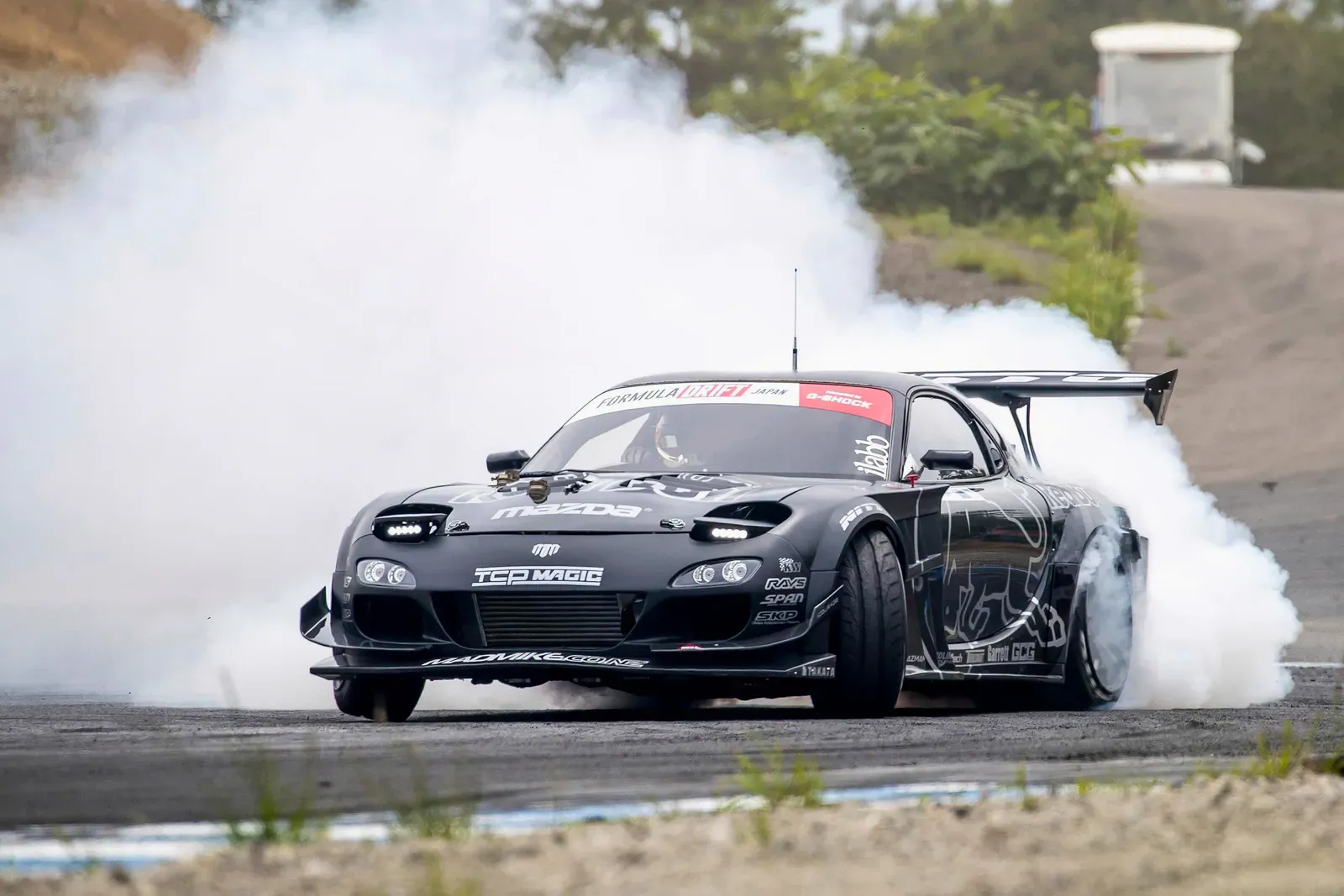
D1GP scores a drift in two stages. Each driver makes two solo runs, then the top 16 enter a knockout of side-by-side chase battles. Every run is scored by DOSS, the series’ machine scoring system, which measures speed, drift angle, angle stability and the sharpness of the counter-steer. Judges then apply deductions and, for the chasing car, approach points.
The figures below come from D1GP’s own competition, scoring and concept pages, which are in Japanese, so the wording is a translation. The concept page says drivers are judged on how stylish the drift looks, with skill counting for more than machine performance.
How is a D1GP event structured?
A round has a solo stage and a battle stage.
- Solo run (tanso). One car on the course. Every entrant makes two runs. Solo qualifying and seeding were abolished in 2019, and the top 16 go to the battle tournament.
- Battle (tsuiso). Two cars run together, a leader and a chaser. A match is two runs with the roles swapped, and the combined score of both runs decides it.
- Bracket. Single elimination. The last driver standing wins.
D1GP is the top category. D1 Lights, the feeder category, is scored without DOSS, and D1 Divisional, the regional category, has run since 2006. This guide covers D1GP.
What is DOSS?
DOSS, the D1 Original Scoring System, is the machine that scores each run. D1GP introduced it in 2013; before that, judges alone scored each run. It measures speed, drift angle, angle stability and the sharpness of the counter-steer. D1GP refines it every year, and since 2019 it also scores the chasing car.
How is a solo run scored?
A solo score is a sum of weighted course sectors, minus deductions. The course is split into four or five sectors, each with its own weight, and the weights vary by course. One example on the scoring page, from a 2019 round in Hokkaido, weights five sectors at 15, 10, 30, 25 and 20 per cent.
Since 2019, courses also carry designated zones that the car must pass. The deductions on the scoring page:
| Fault | Detail | Points lost |
|---|---|---|
| Missed zone | Designated zone not passed | 1 to 3 |
| Double flick | At initiation or drift-under, in the page's wording | 5 |
| Off course | 1 to 2 wheels | 2 |
| Off course | 3 to 4 wheels | 5 |
Smoothness and contact with course objects can also cost points, and the page gives no amounts for either.
How is a battle scored?
Each battle run is scored by DOSS and adjusted by judges. The lead car is scored like a solo run. The chasing car gets a DOSS base score plus approach points from the judges: 6 to 12 per course, awarded sector by sector by the chaser’s distance from the leader. A chase the judges rate as no good challenge costs 2 points. The chaser is not penalised for missed zones or for putting 1 to 2 wheels off the course.
Three rules give the lead run extra weight:
- The leader is scored like a solo run.
- The top eight drivers must lead on their first run.
- Up to the best-16 round, a tie is settled by comparing lead-run DOSS scores. From the best 8, the pair gets one rematch, then lead-run DOSS decides.
Which parts of the scoring change by course or year?
Sector weights vary by course, and D1GP refines DOSS every year. The deduction amounts, the cut to 16 drivers and the points tables appear on the official pages without a course qualifier. Read a score as a result under that round’s course and that season’s version of the system, not as a fixed scale.
How many judges are there, and what do they weigh?
Not found. The competition and scoring pages name the DOSS measures, the zones and the deductions, and give no judge count and no separate line, angle, speed and style breakdown. Treat any such breakdown as unconfirmed by D1GP.
How do series points work?
D1GP’s competition page lists points for solo placing, for final battle placing and for teams. A team with several cars scores its best driver’s points.
| Place | Solo | Battle | Team |
|---|---|---|---|
| 1st | 20 | 25 | 26 |
| 2nd | 16 | 21 | 20 |
| 3rd | 15 | 18 | 15 |
| 4th | 14 | 16 | 10 |
| 5th | 13 | 13 | 6 |
| 6th | 12 | 12 | 6 |
| 7th | 11 | 11 | 6 |
| 8th | 10 | 10 | 6 |
| 9th | 8 | 8 | 3 |
| 10th | 7 | 7 | 3 |
| 11th | 6 | 6 | 3 |
| 12th | 5 | 5 | 3 |
| 13th | 4 | 4 | 3 |
| 14th | 3 | 3 | 3 |
| 15th | 2 | 2 | 3 |
| 16th | 1 | 1 | 3 |
The top four solo places also earn bonus points of 4, 3, 2 and 1.
Where were the 2026 rounds run?
The 2026 series ran five pairs of rounds, ending with the TOKYO DRIFT finale in Odaiba, Tokyo.
| Rounds | Dates in 2026 | Venue |
|---|---|---|
| 1 and 2 | 9 and 10 May | Aichi Sky Expo |
| 3 and 4 | 27 and 28 June | Tsukuba |
| 5 and 6 | 26 and 27 September | Ebisu |
| 7 and 8 | 24 and 25 October | Autopolis, Oita |
| 9 and 10 | 14 and 15 November | Odaiba, Tokyo |
To verify The scoring pages carry no season stamp. A secondary report says 2026 brought back a Best 24 round at some events and added a race-director score correction for lead-car errors, and neither appears on the official pages. Confirm any detail against the 2026 regulations on the D1GP site.
Where next?
- The Drift hub: history, rides and winter options.
- D1GP finale tickets from abroad: prices, sale dates and the overseas page for the 2026 Odaiba finale.
- Japanese sports cars, museums and events: the cars, four museums and Tokyo Auto Salon.
- Which IDP do you need for a drift lesson in Japan?: drive a drift car yourself on a closed course.
Quick answers
How is drifting scored in D1GP?
By DOSS, a machine scoring system that measures speed, drift angle, angle stability and the sharpness of the counter-steer. Judges then apply deductions for faults such as missed zones and leaving the course, and award approach points to the chasing car.
How many judges score a D1GP run?
Not found. D1GP's competition and scoring pages give no judge count and no separate line, angle, speed and style breakdown.
How many drivers reach the D1GP battles?
The top 16. Every driver makes two solo runs, and the top 16 enter a single-elimination chase tournament. Solo qualifying and seeding were abolished in 2019.
What happens when a D1GP battle is tied?
Up to the best-16 round, lead-run DOSS scores are compared. From the best 8, the pair gets one rematch, then lead-run DOSS decides.
How many points does a D1GP win earn?
25 points for winning the battle tournament, 20 for the best solo placing, and 26 for the best team. Top four solo places also earn a 4, 3, 2 or 1 point bonus.